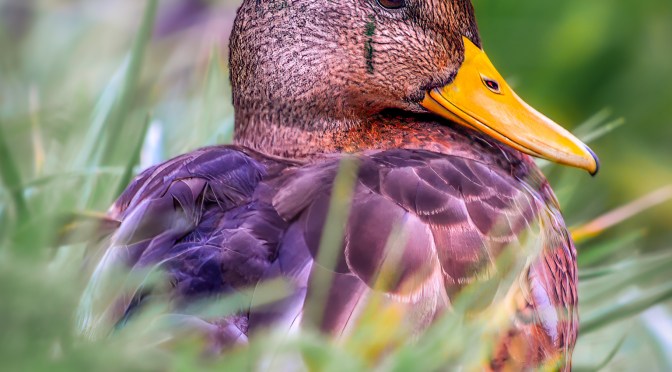

Wildlife photography isn’t always about action or drama — sometimes, the most compelling moments are the quiet ones. This duck portrait, taken in soft focus and nestled among spring grass, captures one of those rare pauses. Half-hidden by gently swaying blades, the mallard offered a calm, unguarded moment in the golden afternoon light — a perfect reminder of the beauty found in stillness.
The Encounter
I captured this image near a small urban pond in central Poland — a familiar location where mallards are common but rarely this calm. That day, one duck lingered longer than most, unbothered by my slow, deliberate approach. It didn’t take flight or shift nervously; instead, it rested in the grass, head tucked slightly back, framed by light and foliage. What captivated me wasn’t only the duck itself, but the atmosphere — soft textures, layered color, and the unspoken trust of a quiet subject.
Photography Details
- Photography Details:
Camera setup: Handheld, using a telephoto lens for subject isolation and minimal intrusion.
Shutter speed: 1/30 sec — fast enough to hold sharpness while maintaining softness in the plumage. - Aperture: f/5.6 — offering crisp focus on the eye and head while allowing a smooth falloff into background blur.
- ISO: 220 — ideal for natural light with minimal noise.
- Focal length: ~300 mm (APS-C) — enabling compression and separation without disrupting the subject.
- Composition: This duck portrait was composed to emphasize intimacy and tranquility. I shot low and close, almost at ground level, to create a shared point of view with the subject. The decision to frame the image tightly, allowing the blurred grass in the foreground to dominate, was deliberate — it forms a natural vignette, softening the edges and guiding the eye inward.
The image is built on gentle curves: the arc of the duck’s back, the slope of its neck, the tilt of the bill. These lines draw the viewer toward the eye, which serves as the focal anchor. The background dissolves into painterly green and yellow tones, helping the subject emerge without stark contrast. Instead of dramatic lighting, I relied on selective softness and layering to create depth — making the duck feel present, yet peacefully embedded in its environment.
A centered, slightly off-angle composition gave me room to include both feather texture and soft grasses, balancing detail and blur. The natural light was diffused enough to avoid hard shadows, and the duck’s slight head turn added just the right amount of engagement, turning a passive scene into an intimate moment. - Post-Processing: The editing approach for this duck portrait was gentle — focused on enhancing the photograph’s quiet mood while drawing out detail where it matters most.
In Adobe Camera Raw, I made a slight lift in exposure to brighten the midtones and introduced a warm color balance to complement the yellow-orange bill and earthy feather tones. The grass’s greens were carefully adjusted to avoid oversaturation, preserving the natural softness of the scene.
In Photoshop, I performed targeted sharpening, limiting it to the duck’s eye, bill, and a few feather ridges around the head. This creates a clear focal point without compromising the overall softness. The surrounding plumage and foreground grass were left unsharpened to maintain the dreamy quality of the frame.
Dodging was used subtly on the duck’s beak, brow, and eye — helping to catch the viewer’s attention gently without artificial highlights. I burned down a few bright or overly reflective blades of grass, particularly on the left side, where they threatened to pull the eye away from the subject.
Finally, I added a soft vignette, feathered broadly, to reinforce the central focus and mute the outer edges. This not only draws attention inward but also enhances the sense of enclosure — as if you’re peeking through the grass into the duck’s resting place. The final look stays faithful to the original scene, with just enough polish to match what I felt in the moment.
Final Thoughts
This duck portrait isn’t about motion or rare wildlife behavior — it’s about quiet connection. Moments like these are often overlooked in favor of action shots, but there’s profound beauty in stillness. When you slow down, lower your perspective, and observe with patience, even the most common birds can offer extraordinary encounters.
Have you ever photographed wildlife at rest — without the chase, without the spectacle? I’d love to see your quiet portraits or hear about the moments that stopped you in your tracks. Share your stories or images in the comments below!
Discover more from Shutter and Saddle
Subscribe to get the latest posts sent to your email.
 Shutter and Saddle
Spectacular image! I love the out-of-focus greenery in the foreground which emphasizes the crisp details you’ve captured in the focus field. Wonderful colours and textures.
LikeLiked by 1 person
Thank you so much! I’m glad you noticed those details – the foreground blur was intentional to create a sense of peeking through the grass at the duck’s quiet moment. The warm tones and textures in the feathers were a gift from the golden hour light. Really appreciate you taking the time to share your thoughts!
LikeLiked by 1 person
My pleasure, Mike!
LikeLiked by 1 person