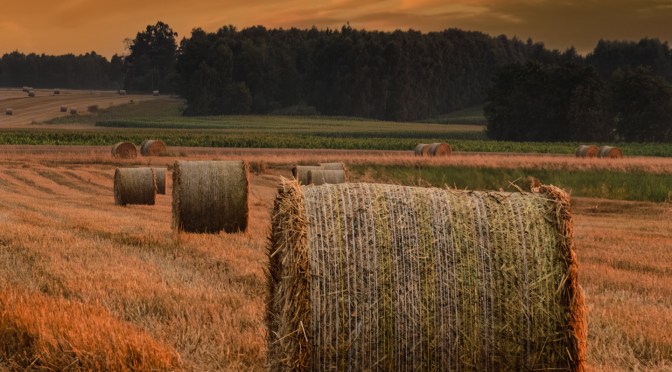
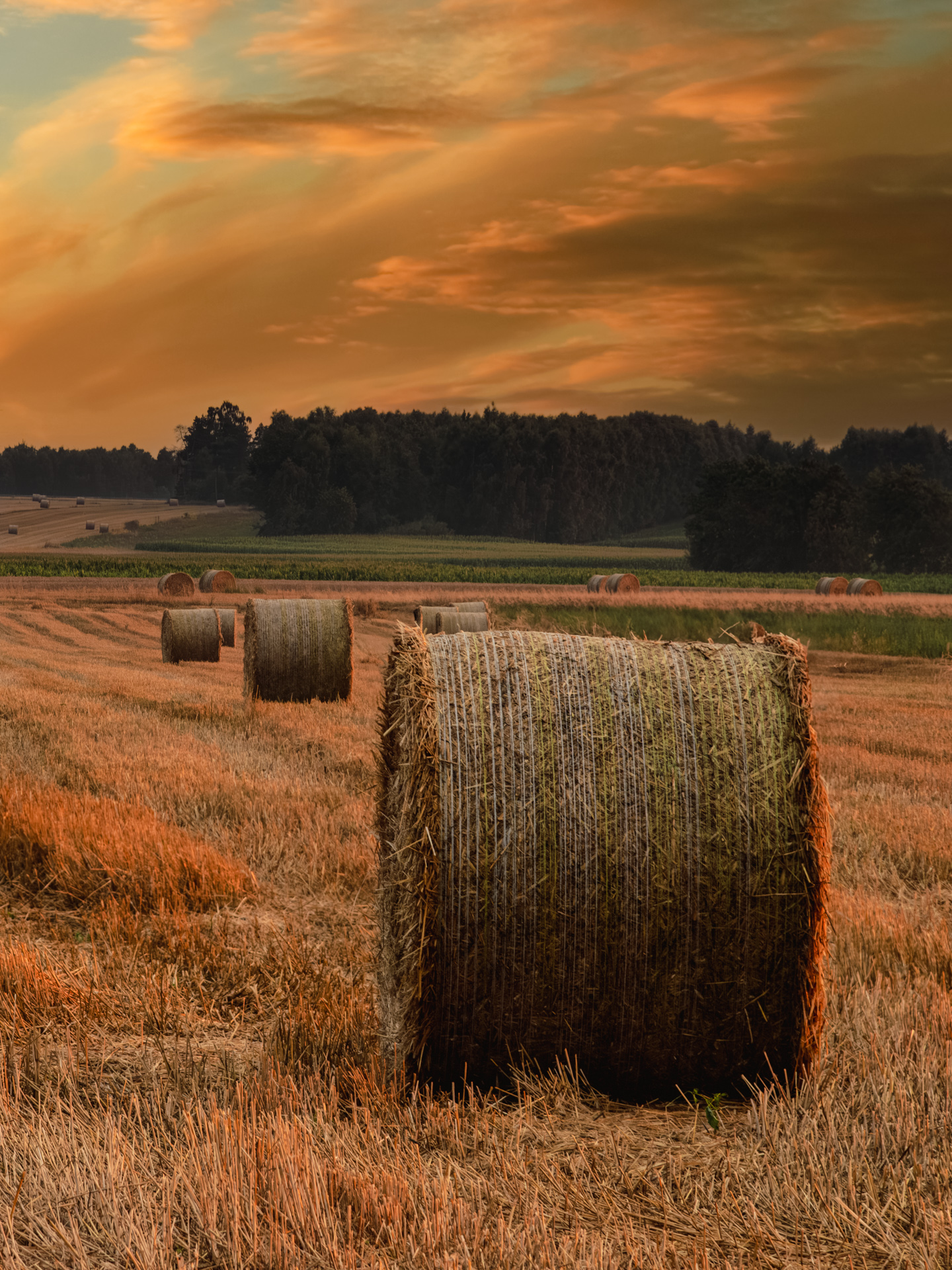
July lingers — yet already, the Polish countryside hums with signs of the coming harvest. In this golden-hour landscape, hay bales scatter across the fields, long shadows stretch toward the treeline, and the sun dips low, casting a soft, amber light that feels more like late August than midsummer.
Whether it’s a result of this year’s weather or simply the rhythm of the land, the atmosphere hints at change. And for me, these early signs spark a familiar anticipation. Soon, my kitchen will be filled with the scent of bubbling plum jams and herb-scented pickles, while bottles of elderberry syrup and currant juice quietly line the shelves. The harvest is more than a moment — it’s a rhythm we live by. And it begins in scenes like this, captured before the season officially turns.
Photographic Approach
This rural summer scene wasn’t about drama — it was about subtle storytelling. I was drawn to the natural repetition of hay bales laid out in quiet formation, their texture glowing under the golden hour sky. I positioned the largest bale in the foreground, slightly off-center, to act as a visual anchor. The curve of the mown path behind it adds a gentle sense of motion through the frame.
In landscape photography, balance often comes from contrast — here, between the soft golden light and the darker forest at the edge of the field. The deepening tones in the background helped hold the composition together, preventing the viewer’s gaze from slipping away.
The layered depth — from the stubbled foreground to the distant treeline and sky — evokes both space and time, echoing the slow turning of the season.
Post-Processing in Camera Raw and Photoshop
I captured this image in RAW format to preserve subtle light gradations and ensure full control over shadows, highlights, and fine details during editing. The post-processing was done in Adobe Camera Raw and Photoshop — a combination that allowed me to shape the photo while staying true to the natural ambiance of the scene.
In Camera Raw, I started by applying the Adobe Landscape profile to enhance natural colors and contrast without oversaturating the field. I slightly increased the exposure to lift the midtones, pulled back the highlights to recover detail in the sky, and raised the shadows to reveal depth in the hay and foreground texture. The whites and blacks were gently adjusted to fine-tune the dynamic range and add clarity.
Using the Color Mixer, I warmed up the orange and yellow channels and brightened their luminance to emphasize the sunlit grass and hay bales. In the Color Grading panel, I added a soft golden tone to the highlights and cooled the shadows with a touch of blue — creating a subtle tonal contrast that evokes both warmth and calm.
Finally, a delicate vignette helped draw focus toward the center of the frame, adding a hint of intimacy to the open space.
Once inside Photoshop, I took the opportunity to clean up the scene. Despite its rural charm, the field had a few modern intrusions: plastic wrappers hiding in the grass, distant trash bins near the tree line, and even a few tourists walking across the background. With the Spot Healing Brush and Content-Aware Fill, they vanished — no offense to the tourists, but their shorts didn’t really match the mood 🙂
I used Luminosity Masks to selectively deepen the shadows around the hay bales, giving them more presence without darkening the entire scene. Then, to enhance the dreamy glow of sunset without making the image look artificial, I applied a gentle Orton Effect to the background and sky — just enough to infuse the image with softness, as if the light itself had memory.
This post-processing approach — balancing cleanup, tonal harmony, and mood enhancement — is typical of how I finish my rural landscape photos, especially when light and season play such a central role in the image.
Final Thoughts
There’s a certain poetry in watching the land shift before the calendar does — a quiet turning of the page that signals not an ending, but a deepening. This photograph holds that moment: when summer leans into harvest, and the warmth of the day begins to take on the weight of what’s to come.
The hay bales in the field are more than just agricultural detail; they’re part of a cycle that speaks of labor, preparation, and tradition. They remind us to slow down, take stock, and — like any good photographer or gardener — be ready for what the season brings.
In the end, developing a photo is not so different from preparing a jar of jam. Both require observation, patience, and a bit of gentle shaping. Whether it’s adjusting curves and color tones or layering plums and sugar, each is an act of care — a quiet love letter to time, memory, and the rhythm of the year.
Want to see how light, color, and mood come together in post-processing? Scroll back up for the full Camera Raw and Photoshop workflow — or head to the field and try it yourself 🌾
Discover more from Shutter and Saddle
Subscribe to get the latest posts sent to your email.
 Shutter and Saddle