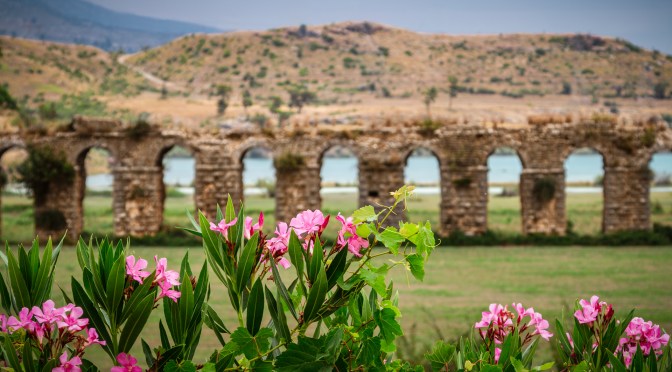

There’s something timeless about ancient ruins that have stood for centuries — silent witnesses to civilizations long gone. On a recent trip, I came across an ancient Roman aqueduct, its majestic arches stretching across the hills as if still carrying water from distant mountains. In the foreground, bright pink oleander blossoms swayed gently in the breeze, offering a vivid contrast to the weathered stone. Together, they created a natural frame — the fleeting beauty of the present embracing the enduring architecture of the past.
The Photographic Approach
This Roman aqueduct photo came together almost instinctively. The oleander blossoms weren’t just decorative; they became the anchor of the entire composition. Their vibrant color and sharp, detailed leaves contrasted beautifully with the aqueduct’s repeating arches and the soft, muted tones of the hills beyond.
To create depth, I focused on the flowers while allowing the aqueduct and background to soften into a gentle bokeh. This layering — vivid blossoms in the foreground, structured arches in the middle, and hazy hills in the distance — gave the scene both dimension and atmosphere.
The main challenge was separation. The aqueduct’s stone matched the dry hillside so closely that the two blended together. Careful post-processing would be essential to let the ancient structure stand apart as the true subject.
Photography & Post-Processing Details
Back at the computer, I started in Camera Raw, choosing the Modern 03 profile as my base. It gave the image a gentle cinematic tone — richer and more nuanced than a flat profile, but without oversaturating the natural colors.
From there, I worked toward a softer, more pastel mood:
- Lowering contrast and lifting shadows revealed subtle details inside the arches.
- Reducing clarity avoided a harsh, crunchy look, lending a dreamy, film-like quality.
- In color grading, I blended cool shadows, warm peach highlights, and a hint of teal midtones for a subtle matte atmosphere.
The aqueduct itself needed extra care. Targeted adjustments increased texture and midtone brightness so the stones stood out from the background. I also desaturated the yellows of the hills, preventing them from competing with the aqueduct’s warm stonework.
In Photoshop, I refined the scene further. A soft gradient mask brightened the upper sky, adding a pastel glow instead of leaving it flat. I removed modern electricity pylons from the hills, distractions that clashed with the timeless character of the view. Finally, a subtle Orton effect softened transitions — keeping detail in the blossoms while letting the background melt into a gentle haze.
Ancient Aqueducts: A Brief Note
Aqueducts were among the Roman Empire’s greatest engineering feats. Powered only by gravity, they carried fresh water across vast distances — sometimes tens of kilometers — from mountain springs into busy cities. They supplied not just drinking water but also fed public baths, fountains, and private homes.
Standing before their ruins today, it’s easy to forget their purely practical purpose and instead see them as monuments. Yet they are direct links to daily life almost two thousand years ago.
Final Thoughts
This photograph is as much about balance as it is about history — the vibrant life of present-day flowers paired with the enduring strength of Roman stone. My post-processing wasn’t about dramatic transformation, but about guiding the viewer’s eye with subtle separation and softening, creating a scene that feels both calm and cinematic.
For me, it became a quiet dialogue between past and present — a reminder that even ancient ruins can bloom again, if only within the frame of a photograph.
Have you visited ancient ruins that left a lasting impression? Share your story below — I’m always curious where others find timeless beauty.
Discover more from Shutter and Saddle
Subscribe to get the latest posts sent to your email.
 Shutter and Saddle