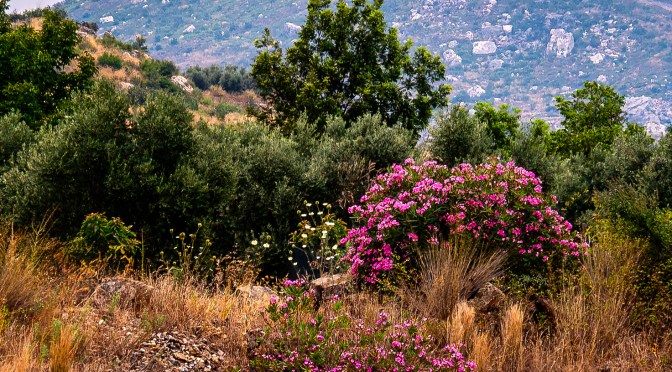

During a quiet summer ride, I came upon a small, turquoise pool reflecting wild shrubs and vibrant pink blossoms. Behind them, a flat-topped limestone ridge stood steady, like a giant’s table overlooking the valley.
It’s the kind of view that feels unmistakably southern: common across southern Europe and Turkey, where rugged terrain suddenly yields to pockets of color and life. For a cyclist, moments like these are a welcome pause; for a photographer, they are a gift waiting to be framed.
Composition
The flowers were my immediate focal point. Their vivid pink cut sharply against the muted greens of olive groves and the gray-blue of the mountain. They became the natural anchor of the scene. From there, the eye follows a gentle line — through the foliage, across the slopes — before resting on the ridge, the highest point in the frame.
This interplay of bloom and stone is a familiar rhythm across the Mediterranean:
- In southern Italy, oleanders spill over ancient walls.
- In coastal Greece, bougainvillea blazes against barren hillsides.
- In Turkey’s Taurus Mountains, wildflowers cling to steep valley edges.
Each variation feels familiar yet distinct, shaped by sun, stone, and sea.
Post-Processing
The original photograph was captured under an overcast sky, which meant the scene looked a little flat. Post-processing was all about gently balancing tones, drawing out detail, and guiding the viewer’s eye.
In Camera Raw, I worked on:
- Balancing exposure — softening the brightest parts of the sky and gently lifting the darker trees so they revealed more shape.
- Adding presence — a touch of texture and clarity brought the blossoms and the rocky ridge into focus, while a hint of dehaze gave the mountain more definition.
- Fine-tuning colors — the flowers were given a subtle boost in vibrance so they stood out naturally, and the water was brightened just enough to keep its turquoise glow.
- Tone and grading — a gentle curve added depth, while color grading gave the image harmony: warmer highlights made the flowers glow, and cooler shadows brought calmness to the water and mountain.
In Photoshop, the finishing touches included:
- Selective dodging and burning — brightening the flowers and ridge line to create a natural path for the eye, while slightly darkening the frame’s edges.
- Sharpening selectively — applied only to the flowers and the ridge, so the details felt crisp where they mattered without making the sky or water harsh.
- A subtle vignette — pulling attention inward in a way that feels almost invisible.
- Experimenting with the Orton Effect — a soft, dreamy glow was tested, but used only sparingly, so the scene kept its detail while gaining a hint of atmosphere.
👉 Tip for cyclists with cameras: When you pause mid-ride to take a photo, think less about perfection and more about where the eye should travel. In post-processing, subtle guidance — brightening here, darkening there — can be more powerful than dramatic changes.
Final Thoughts
What I love most about photographs like this is that they emerge from moments of pause. On the bike, you notice details that blur past in a car window: a sudden splash of color, a ridge catching the light, the texture of water against stone.
These scenes may not be grand landmarks, but they are the landscapes that define the South: rugged, layered, fleetingly colorful.
For me, this photo is a reminder that the most compelling images often come not from chasing perfect light or iconic vistas, but from letting the rhythm of the ride slow you down long enough to see what’s right in front of you.
If this view sparked your wanderlust, stay tuned for more stories and photos from the road — and let me know in the comments what landscapes inspire you most.
Discover more from Shutter and Saddle
Subscribe to get the latest posts sent to your email.
 Shutter and Saddle