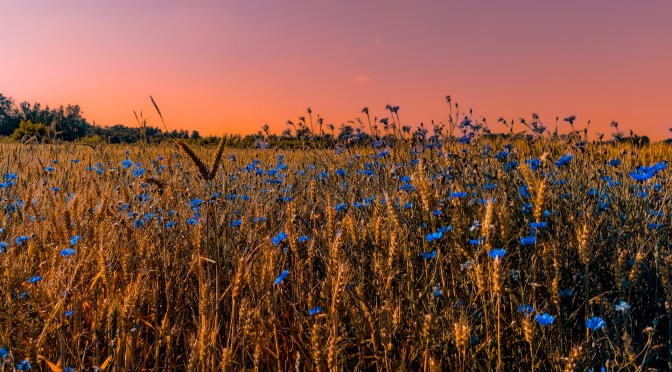
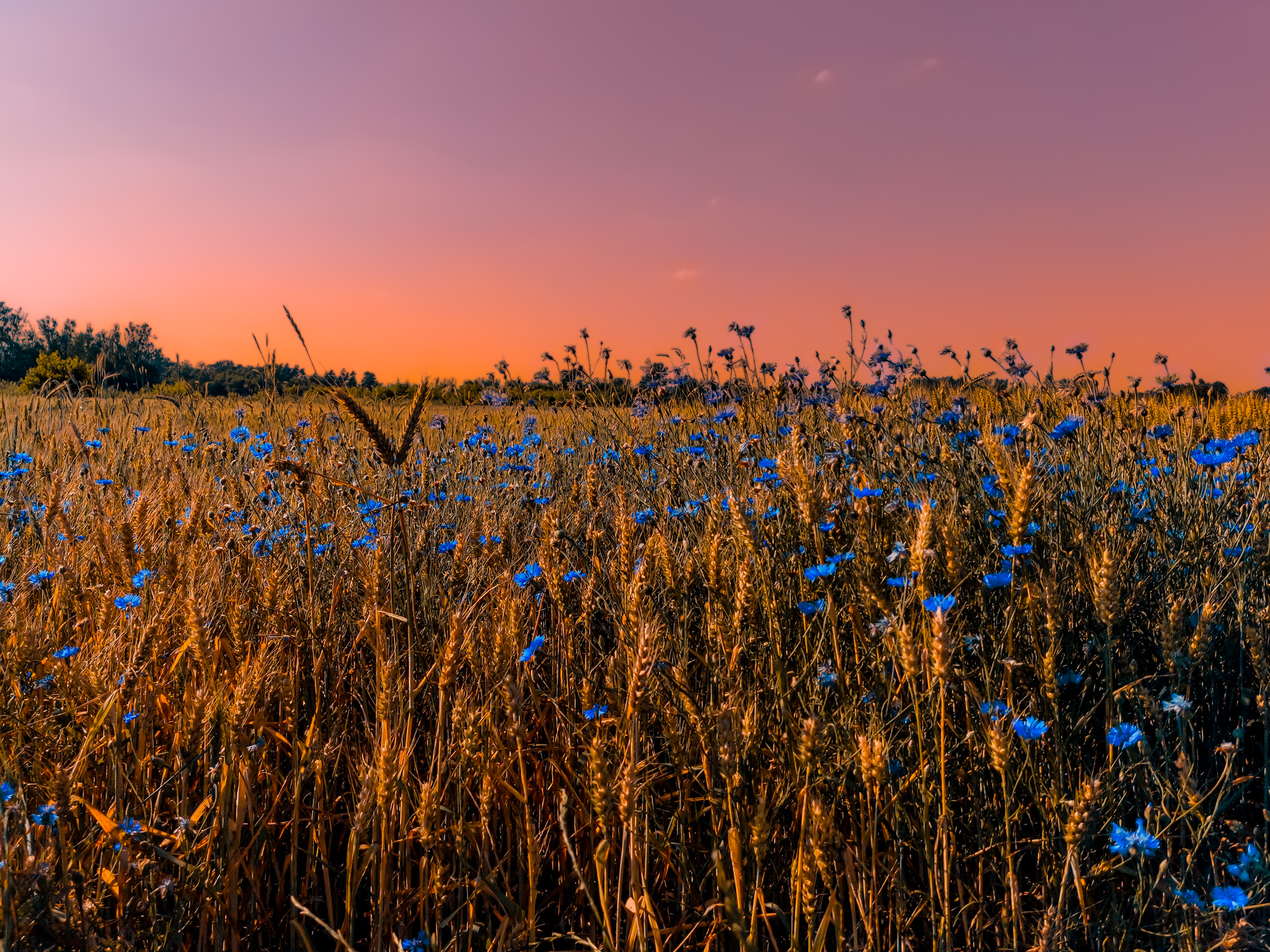
There’s something timeless about a blooming wheat field at sunset — golden stalks swaying in the breeze, cornflowers scattered like blue confetti, and the gentle hush of a summer evening settling in.
This photo dates back several years, to a time when I was just beginning to explore digital photography and experiment with Lightroom post-processing. It was one of my first real attempts at editing — and it shows.
Looking at it now, I know the colors are far from subtle — especially the vivid blues — but the image still brings back a deep sense of calm and wonder. And in today’s world of overprocessed images on Instagram and other platforms, maybe there’s something refreshing about that boldness.
Composition
Some landscapes practically compose themselves, and this scene was one of those moments. I came across this wheat field near the edge of a forest as the sun dipped toward the horizon, bathing everything in warm, golden light.
I crouched low among the stalks, framing the scene so that the blue cornflowers filled the foreground. Their petals stand out dramatically against the golden wheat, while the distant tree line offers a flat, calming contrast on the horizon.
The vertical rhythm of the wheat gives the image structure, with one darker ear of rye near the center breaking the pattern just enough to hold the eye. Above, the sky transitions from orange to soft violet — a natural gradient that wraps the photo in warm and cool tones at once.
There are no forced leading lines or dominant focal points here. This is more about mood than precision — an invitation to let your gaze drift naturally across the textures and hues, just as you would if you were standing in the field.
Post-Processing
This was one of the first photos I edited with real intention in Adobe Lightroom, and it’s easy to tell. Back then, I was fascinated by the HSL panel and eager to push the image as far as it would go. The result? Let’s just say it’s colorful.
Here’s what I did at the time:
- White balance was warmed slightly to bring out the golden tones of the wheat.
- The blue saturation and luminance were pushed far beyond natural levels — the cornflowers almost glow. Unrealistic? Absolutely. But it felt magical to me back then.
- Contrast and Clarity were boosted to enhance texture in the wheat and add visual weight.
- I added a subtle vignette to gently darken the edges and focus attention toward the center.
- A graduated filter was applied to the sky, nudging the upper tones toward purple for added richness.
If I were to edit this image today, I’d definitely hold back — especially on the blues. I’ve learned to prefer more natural color grading and nuanced adjustments. But that’s part of the journey: we all go through phases of experimentation, exaggeration, and discovery.
Final Thoughts
This scene captures the quiet beauty of winter. The interplay of light and shadow transforms a cold landscape into something warm and inviting. Moments like these highlight the magic of nature, even in the depths of winter.
This image is more than a field at sunset — it’s a memory from when I was learning to see, to compose, and to process. The bold editing may not match my current style, but it reminds me of a time when every new tool in Lightroom felt like magic.
In an era where social media is filled with hyper-saturated landscapes and perfectly polished scenes, I think there’s room for both authenticity and exaggeration. Sometimes people aren’t searching for realism — they’re looking for feeling. And if this photo still makes me feel something, I’ll count that as a success.
📸 Curious how your editing style evolves over time? Dig into your photo archive and see what still speaks to you. For more photo stories and Lightroom tips, explore the rest of the blog and follow along!
Discover more from Shutter and Saddle
Subscribe to get the latest posts sent to your email.
 Shutter and Saddle
Such a magical and captivating image.
LikeLiked by 1 person
Thanks! It was one of those moments you just have to capture. 😊
LikeLike